

Diving Deep into the Book of James
Recently I made it to Day 326 out of 365 in The Bible Recap Bible reading and podcast study plan.

The creator of The Bible Recap, Tara Leigh Cobble, organizes this “read the Bible in one year” experience through reading the Bible in chronological (timeline) order. This order differs from the traditional way our Bibles are organized by similar genres of writing (gospels, church history, letters, wisdom, and prophecy).
See this image below to explore the chronological timeline order in which the books of the New Testament were written:
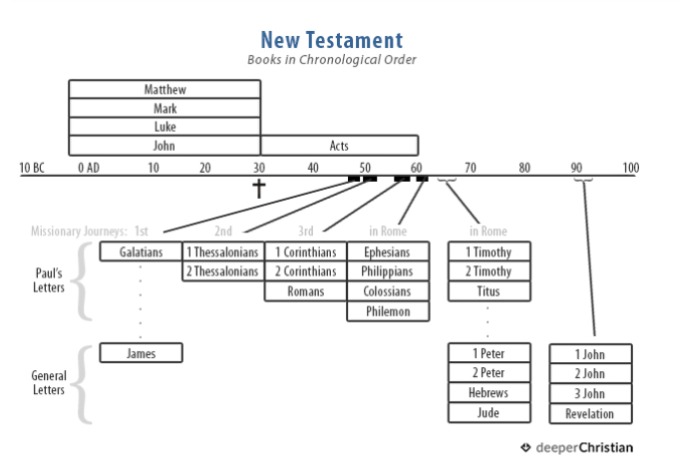
*Photo credit to DeeperChristian
When I opened up the Youversion app to see which chapters we were reading that day, I was surprised to see we were reading the entire book of James in one day. When I studied the book of James in the past, I read only a few verses at a time. However, when I read the book in its entirety, my spiritual eyes were opened to the overarching themes of the letter in a fresh way.

If this feels overwhelming to read an entire book of the Bible (even if there aren’t many chapters), check out The Bible App by YouVersion. You can pick most versions of the Bible to listen to a narrator read the text aloud. By listening to the audio version, you can focus more on comprehending what you are reading and avoid getting stuck on unfamiliar names and places. YouVersion makes this super simple, because they have a Bible reading plan that matches The Bible Recap’s scope and sequence. This year, I listened to the CSB version (Christian Standard Bible).
Another valuable component of The Bible Recap is Tara Leigh’s inclusion of helpful articles and videos to help listeners gain an even deeper perspective on the scriptures. The Bible Project’s videos are linked into The Bible Recap plan each time we begin reading a new book of the Bible.
With these resources, I learned that:
- Bible scholars consider James as the wisdom book of the New Testament. With similarities to the Old Testament book of Proverbs, James connects wisdom from both the traditional Jewish faith to the teachings of Jesus for new believers.
- This is the first letter written to the Jewish Christians in Jerusalem after Jesus ascended to Heaven. It takes place between Acts chapters 14-15. In many Bibles, the book of James is included right after Hebrews. Reading the book chronologically helps us consider the historical context in which James’ lived as we explore the wisdom he shares.
- In Acts chapter 14: early followers of Jesus experienced dangerous persecution for their faith. However, as Jewish and Roman leaders forced Jesus’ followers to leave Jerusalem, the gospel (good news about Jesus saving us from our sins) spread throughout the surrounding communities. Many more people heard the gospel and followed Jesus, too. The gospel truth multiplied throughout the area.
- The Book of James: in the face of intense personal danger, James encourages early followers to see trials as a method to refine their faith. He writes with credibility, because he personally experienced these challenges and still found peace and purpose through enduring these obstacles.
- In Acts chapter 15: Peter and James spoke in favor of openly inviting Christians into their Messianic Jewish communities (combining people who were raised as Jewish, but converted to Christianity with non-Jewish Christians).
- James authentically lived out the wisdom the Holy Spirit inspired him to write. When we read his challenge for believers to “Consider it joy when you encounter challenges,” he speaks with authority of being one of the first Christian martyrs, only a few months after he wrote this letter.

Practical Applications 2,000 Years Later
Through this deep dive into the book of James, one truth that stands out to me is: authenticity matters. A person could write all sorts of truth, but unless they have the life experiences to earn this wisdom, their words don’t carry as much weight. Knowing James experienced persecution to the point of death inspires me to confidently trust that when James champions us to “consider it joy when we experience trials,” that he lived a life that exemplified this mission.
I don’t know about you, but when trials come my direction, joy is the furthest thing from my radar. Instead of considering the joy of what I will gain from enduring the trial, I immediately launch into crisis mode. Like an ER physician, I assess the situation (is it immediate, urgent, or non-urgent), and determine how to safely solve the trial.
Instead of jumping into “fix-it” mode, what if we paused to consider the bigger picture of the trial in relation to our faith journey?
Perhaps, if we take a big picture look at our trial, we could trust the Lord will use this trial to:
- grow our faith and produce spiritual endurance. (verse 3)
- transform our faith to be mature and complete, lacking nothing. (verse 4)
With this mindset, I am working diligently to rewrite my natural line of questioning from “Why is this happening to me?” to “Why not me?”
As we continue to navigate different medical diagnoses and focus/attention challenges, as an educator and researcher, I am beginning to realize that maybe the Lord created me with these passions and giftings, so I would be empowered to help my own child with his learning needs. Maybe the lessons he teaches me in this season of life will empower me to better serve the children and teachers that I teach both now and in the future. Perhaps the trials we face bring out our God-given strengths that we otherwise wouldn’t know were within us.
Friend, as you consider the trials that you are currently walking through, I want to encourage you to take a step back to consider:
- What unique facets of your personality and passions might be intentionally designed to empower you to tackle the trial in front of you?
When we can step back from the “here and now” and look forward to the bigger picture of the season of life, we can begin to imagine the joy that may result from overcoming the trial we face. Thank you Lord for using the challenging parts of our lives for Your glory and our good.
Check out these links for additional resources
- Free! Phone wallpaper of James: 1-2-4
- The Bible Recap
- The Bible Project book of James video
- The Bible App from YouVersion

 The Living Legacy
Thank you for this encouragement today. I have a difficult time considering it joy when facing trials – I often want to speed up the Lord’s timeline and get through the trial quickly. However, as I look back, I can see areas where my faith and relationship with the Lord has grown because of such trials. Producing spiritual endurance and transforming my faith to be mature and complete, lacking nothing really hit home with me this morning while reading your post. Even though I’d love to learn lessons and mature quickly, I need to trust His ways are best and that He will use any trial for my good and His glory.
LikeLiked by 1 person
Thank you so much for sharing your connections, Kelcey! I’m thankful we can process our trials together each step of the way.
LikeLike